
.jpg) Milan Hans
-October 08, 2026
Milan Hans
-October 08, 2026
Indian schools are using AI in 2026 for three kinds of work: running the school, supporting teachers, and helping students and parents. Principals use it for attendance, fee follow-ups, admissions and reports. Teachers use it to plan lessons, create question papers and spot students who are falling behind. Students and parents use it for doubt-solving, practice and progress updates. In every case AI does the repetitive part, and a person makes the decision.
Key takeaways
- AI in schools is mostly quiet, practical work: marking attendance, drafting a worksheet, flagging a fee that is overdue.
- The biggest gain is time. Teachers get hours back from paperwork and spend them on students.
- AI does not replace teachers. It gives a teacher a first draft, and the teacher decides what goes to the class.
- CBSE has brought computational thinking and AI into the curriculum for Classes 3 to 8 from 2026-27, so students now learn about AI as well as with it.
- Student data is the main risk. Use tools the school has approved, and never paste children's personal details into public AI apps.
Four questions I hear in almost every school I visit
I spend a good part of my working life inside schools. I sit in staff rooms, talk to principals in their offices and meet parents at the gate.
For the last year or so, every one of these conversations has ended up at AI. What surprised me is that almost nobody asks about software. They ask about people.
Four questions come up again and again:
- Teachers ask why AI finds something to change in every draft they show it, and say it is hurting their confidence.
- Parents ask whether they should push their children towards AI, and whether those jobs will still exist in twenty years.
- Schools ask how to make teachers faster with AI without making them dependent on it.
- Everyone asks what to do about children who get AI to do their assignments.
These are the right questions. A school can buy every AI tool on the market and still get this part wrong.
So this article does two things. First it lists the 15 ways I see Indian schools using AI today, grouped by who benefits. Then it answers these four questions as honestly as I can.
What are the 15 ways Indian schools are using AI?
The table lists each use, who it helps, and what it replaces. Uses 1 to 5 are for principals and school owners, 6 to 10 for teachers, and 11 to 15 for parents and students.
|
# |
Use of AI |
Who it helps |
What it replaces |
|---|---|---|---|
|
1 |
Face recognition attendance |
Principal, office |
Roll calls and paper registers |
|
2 |
Fee reminders and defaulter prediction |
Principal, accounts |
Manual follow-up calls |
|
3 |
Admission enquiry follow-up |
Principal, admission desk |
Notebooks and missed call-backs |
|
4 |
Reports and dashboards |
Principal, management |
Asking staff for updates |
|
5 |
Timetable and substitution planning |
Principal, coordinators |
Days of manual scheduling |
|
6 |
Lesson planning |
Teachers |
Planning every lesson from a blank page |
|
7 |
Question papers and quizzes |
Teachers |
Typing papers by hand |
|
8 |
Worksheets at different levels |
Teachers |
One worksheet for the whole class |
|
9 |
Spotting students who need help |
Teachers, class teachers |
Finding out at the final exam |
|
10 |
Report card remarks and progress cards |
Teachers |
Writing the same remark forty times |
|
11 |
AI tutor for doubts at home |
Students |
Waiting until the next class |
|
12 |
Personalised practice and revision |
Students |
The same homework for everyone |
|
13 |
Instant updates and answers for parents |
Parents |
Calling the school office |
|
14 |
Communication in the parent's language |
Parents |
English-only notices |
|
15 |
Learning AI, coding and robotics |
Students |
Reading about technology without using it |
How are principals and school owners using AI?
Principals use AI to see what is happening in the school without chasing people for it. The five uses below are where most schools begin, because the results show within weeks.
1. Face recognition attendance
A camera at the gate or classroom recognises each student and staff member and marks attendance on its own. No roll call, no register, no proxy.
The teacher gets back the first ten minutes of every day, and parents receive an alert the moment their child is marked present or absent. For the principal, late arrivals and frequent absentees show up on a dashboard instead of being discovered at the end of the month.
Class ON offers this through its school attendance solution, including face recognition with Hikvision devices.
2. Fee reminders and spotting likely defaulters
Fee software now sends reminders on its own, on the right date, to the right parent, with the exact amount due and a payment link. Smarter systems also look at past payment patterns and point out which families are likely to pay late, so the accounts team can speak to them early.
This is one of the most useful changes for a school's cash flow. The follow-up that used to depend on one clerk's memory now happens every time. See how it works in Class ON's school fee software.
3. Admission enquiry follow-up
Every enquiry from the website, a WhatsApp message or a walk-in is captured in one place. The system reminds the admission team who to call today, drafts the follow-up message, and shows which enquiries are most likely to convert.
Most admissions are lost to slow follow-up, not to competition. A school CRM makes sure no parent is forgotten. Our post on why parents choose one school over another explains why speed matters so much.
4. Reports and dashboards that explain themselves
Instead of asking five people for five registers, the principal opens one screen: today's attendance, fees collected this week, pending dues, enquiries received, exam results by class.
AI-generated reports go a step further and point out what changed. Class 8 attendance has fallen for three weeks. Collections are behind last October. Section B scored lower in science than Section A. The principal's time goes into acting on the report, not preparing it.
5. Timetable and substitution planning
Building a timetable by hand takes coordinators days, and one teacher's leave can undo it. AI-assisted timetable tools place teachers, subjects, rooms and periods without clashes, and suggest a free teacher for substitution when someone is absent.
The school gets a balanced timetable in hours, and no class sits empty because nobody noticed. Class ON's timetable software handles this.
How are teachers using AI?
Teachers use AI as a first-draft assistant. It prepares the material, and the teacher checks it, changes it and decides what reaches the class. Used this way, AI saves the hours that teachers lose to typing and formatting.
6. Lesson planning
A teacher types the class, subject, chapter and period length, and gets a draft plan: learning outcomes, an opening activity, the explanation, questions to ask, and a short recap.
No teacher should use that draft as it is. But editing a plan takes fifteen minutes, and writing one from nothing can take an hour. Good plans also suggest activities and real-life examples, which helps teachers move towards the activity-based learning that NEP 2020 asks for.
7. Question papers and quizzes
AI can draft a question paper from a chapter or a blueprint: so many one-mark questions, so many case-based, at a chosen difficulty, with an answer key. It can also turn a paragraph of text into a five-question quiz for the end of a period.
The teacher's job is to check every question for accuracy and for fit with what was actually taught. Class ON's Question Bank helps schools build and reuse exam papers in this way.
8. Worksheets at different levels
In every class some children are ahead, most are in the middle, and a few are struggling. A single worksheet suits only the middle group.
With AI, a teacher can produce three versions of the same worksheet in minutes: one for practice of basics, one at class level and one that stretches the fast learners. This is the simplest form of personalised learning, and it needs nothing more than a printer.
9. Spotting students who need help early
When attendance, test marks and homework records sit in one system, patterns become visible. A child whose marks have dropped across three tests, or who has been absent every Monday for a month, is flagged for the class teacher.
The value is in the timing. A teacher who knows in August can speak to the parent and arrange support. A teacher who finds out in the March result cannot. Tools such as Class ON's student analyser bring this information together.
10. Report card remarks and progress cards
Writing individual remarks for forty students, in three terms, is slow work, and by the thirtieth child the remarks start to sound the same.
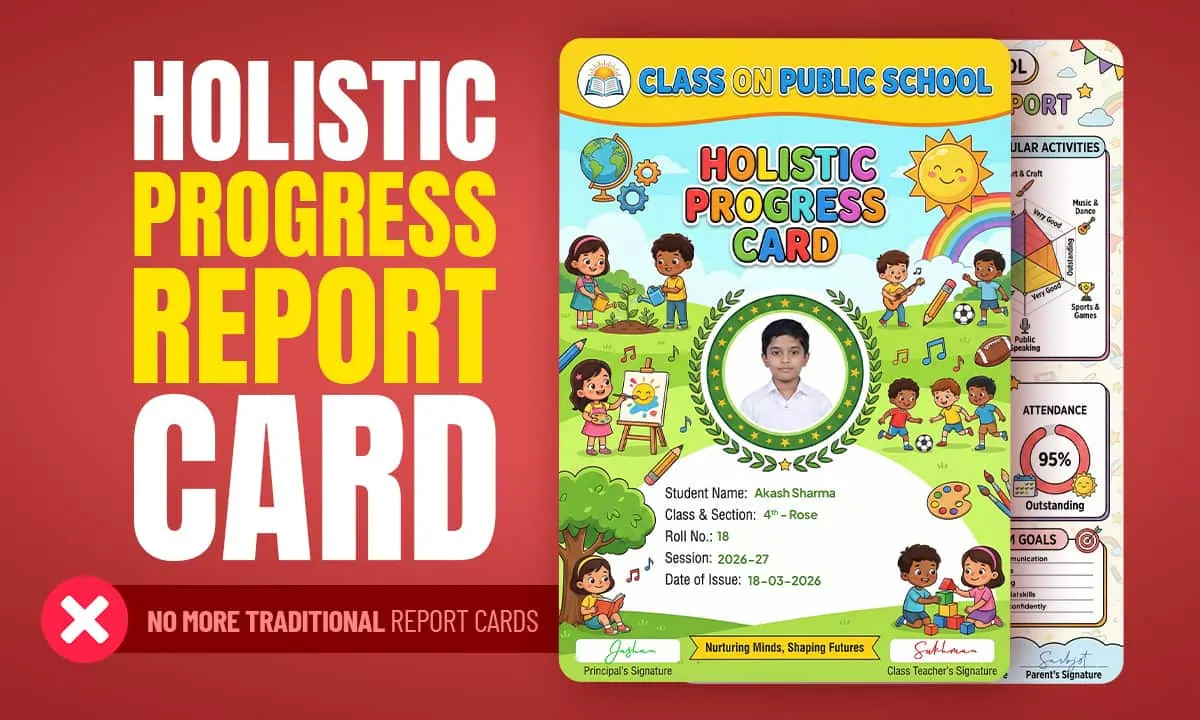
AI can draft a remark from each child's actual marks, attendance and teacher notes, which the teacher then personalises. This matters more now that schools are moving to the Holistic Progress Card, which reports on skills, behaviour and participation as well as marks.
Will AI replace teachers?
No. AI can prepare material, but it cannot notice that a child is upset, hold a class's attention, or earn a student's trust. What changes is how a teacher's time is spent: less on paperwork, more on children. The teachers who learn to use these tools will simply have more of that time than those who do not.
How does AI help parents and students?
For families, AI means faster answers and learning that fits the child. Parents know more about their child's day, and students get help at the moment they are stuck.
11. An AI tutor for doubts at home
A child stuck on a maths problem at 9 pm no longer has to wait until the next class. An AI tutor explains the step, gives a similar example and checks the child's next attempt.
The good tools guide a student towards the answer instead of handing it over. This is especially useful for families who cannot afford private tuition, or where parents are not able to help with the subject themselves. The Class ON learning platform includes an AI tutor that students can use at home.
12. Personalised practice and revision
AI practice tools notice which questions a student gets wrong and give more of that type. A child weak in fractions gets fractions, and a child who has mastered them moves on.
Students can also create their own revision notes and mock tests before exams. Ten minutes of practice aimed at the right gap is worth more than an hour of repeating what the child already knows.
13. Instant updates and answers for parents
Parents now receive attendance alerts, homework, test marks, fee dues and notices on their phone as they happen. Chat assistants on school apps and websites answer the routine questions, such as the fee due date, the holiday list or the bus timing, at any hour.
The office gets fewer phone calls, and parents feel informed. That feeling is one of the strongest reasons a family stays with a school. See how the Class ON Parent App keeps parents updated.
14. Communication in the parent's own language
India's parents read Hindi, Punjabi, Tamil, Marathi, Bengali and dozens of other languages. AI translation lets a school write a notice once and send it in the language each family is comfortable with. Voice messages help parents who prefer listening to reading.
A notice that is understood gets acted on. Writing to parents in their home language is the simplest way to reduce missed PTMs, forms and deadlines.
15. Learning AI, coding and robotics
The last use is different from the other fourteen. Here students are not only using AI. They are learning how it works.
On 1 April 2026, CBSE launched a curriculum on computational thinking and AI for Classes 3 to 8, for the 2026-27 session (Business Standard). Schools are responding by setting up labs where children build robots, write code and train simple AI models with their own hands.
Class ON's AI & Robotics Lab brings ten such labs under one programme, priced from ₹120 to ₹200 per student per month. Read our full guide to setting up an AI and robotics lab in your school.
The four questions schools ask me about AI, answered
These are the questions from the start of this article. None of them has a perfect answer, but each has a practical one.
Why does AI always suggest changes to a teacher's work?
Because suggesting changes is what it does when you ask it to check something. It is a habit of the tool, not a verdict on the teacher.
You can prove this to your staff in two minutes. Ask an AI tool to write a paragraph. Then paste that same paragraph back and say "improve this". It will find changes to make in its own writing. Different is not the same as better.
Three things help teachers keep their confidence:
- Change the question. Instead of "improve this", ask: "Is there any factual mistake or unclear line here? If not, say it is fine." You will get far fewer suggestions, and the ones you get will matter.
- Remember who the judge is. AI does not know your class or which child gets stuck where. Accepting or rejecting a suggestion is the teacher's call.
- Polish is not a teacher's value. A calculator multiplies faster than any maths teacher, and nobody thinks less of the teacher for it. A teacher's worth lies in understanding children, not in making a sentence shine.
Should parents push their children towards a career in AI?
Nobody can guarantee any career for the next twenty or thirty years. Anyone who offers that guarantee is usually selling a course.
The worry behind the question is partly correct. Routine content writing, basic design and basic coding are shrinking, especially for freshers. But the work has moved, not disappeared. A website can now be built in an hour. Deciding what to build, for whom, whether it is right, and who answers for the mistakes is still a person's job.
This is why "learning AI tools" is not a career. The tools change every six months. What lasts longer is this:
- Fundamentals. Maths, language, logical reasoning, and clear writing and speaking. Writing a good prompt is really just thinking clearly.
- Deep knowledge of one field, plus AI. Medicine, law, finance, farming, manufacturing, education. A doctor or accountant who uses AI becomes more valuable. A person who only operates the tool becomes less so.
- Judgment. Only someone who knows the subject can tell whether the AI's answer is right.
- Human work. Selling, leading a team, building trust, negotiating.
- Work in the physical world. Healthcare, skilled trades and robotics hardware are where AI will arrive slowest.
- The habit of learning. This matters most, because today's children will probably have to change skills four or five times in their working lives.
So my answer to parents is this. Every child needs AI literacy, the same way every child once needed computer literacy. A career in building AI, such as machine learning, data or robotics, is real, but it needs strong maths and it is not for everyone.
Many parents tell me that most people do not know how to use AI smartly. They are right. That is the real gap, and it is exactly why schools have to teach it.
How can teachers use AI without becoming dependent on it?
Follow one rule: brain first, then AI.
- Lesson plans. The teacher first spends five minutes writing down what the chapter should achieve and where this class is weak. Only then does AI produce a draft.
- Question papers. The blueprint belongs to the teacher: chapter weightage, the mix of easy, medium and hard questions, and which misunderstanding to test. AI supplies extra questions. The teacher chooses and edits.
- Nothing goes to class unread. AI makes mistakes, and the teacher's name is on the paper.
- Spend the saved time on children. Weak students, doubt-clearing, a conversation with a parent. If time is being saved and going nowhere, the school has gained dependency and nothing else.
Losing a little skill is acceptable, in typing or formatting for example. What a teacher must never lose is the ability to decide what to teach and why.
What should schools do when students use AI for homework?
Banning it or trying to catch it will not work. If an assignment can be finished with one prompt, the assignment has to change.
- Do the thinking work in class. In front of the teacher, written by hand or spoken aloud. Keep reading and practice for home.
- Check the process. Add a two-minute viva to assignments: "Explain your answer." A child who copied is found out on the spot.
- Set personal and local topics. An interview with a grandparent, or a survey of the shops in the neighbourhood. AI does not have this material.
- Use AI in the open. "Take an answer from AI, find three mistakes in it and write a better one." This takes more thinking, not less.
- Teach students to use AI as a tutor. "Do not give me the answer. Give me a hint and test me."
- Go by age. In the junior classes, reading, writing and multiplication tables should be solid without AI. Bring AI in slowly after that. We hand children a calculator only after they know their tables.
What are the risks of using AI in schools?
The main risks are wrong answers, misuse of student data, students copying instead of learning, and unequal access. None of them is a reason to avoid AI. All of them are reasons to set rules before you start.
|
Risk |
What it looks like |
What the school should do |
|---|---|---|
|
Wrong or made-up answers |
An AI tool states a wrong fact or date with full confidence |
A teacher checks every AI-made question, worksheet and remark before it reaches students |
|
Student data leaving the school |
A staff member pastes names, marks or phone numbers into a public AI app |
Allow only school-approved tools, and never enter personal details of students in public apps |
|
Copying instead of learning |
Homework and essays written by AI |
Assess more through classwork, oral questions and projects; teach students when AI use is allowed |
|
Unequal access |
Some children have a phone and data at home, others do not |
Give AI-based practice time in school, not only as homework |
|
Over-reliance |
Teachers stop preparing, students stop thinking |
Treat AI output as a first draft, always |
|
Bias and unfair flags |
A system wrongly labels a child as weak or a family as a defaulter |
A person reviews every flag before anyone acts on it |
What does the law say about student data?
Almost every school student is a "child" under India's Digital Personal Data Protection Act, 2023, which covers anyone below 18. The Act requires verifiable parental consent before a child's personal data is processed, and it restricts tracking, behavioural monitoring and targeted advertising aimed at children.
The DPDP Rules were notified on 13 November 2025. They give educational institutions an exemption for tracking and behavioural monitoring, but only where it is done for the educational purposes of the institution and in the interest of the child's safety (Tsaaro). Attendance and school bus tracking fit that purpose. Selling or sharing student data for marketing does not.
This is a summary, not legal advice. Ask your school's legal adviser how the Act applies to you.
Six rules for safe AI use in a school
- A human decides. AI drafts and suggests. A teacher or principal approves.
- Approved tools only. Keep a short list of AI tools the school permits, and say so in writing.
- No student data in public apps. Names, photos, marks, addresses and phone numbers stay inside school systems.
- Tell parents. Explain which tools the school uses and why, and take consent where it is needed.
- Check before you share. Every AI-made paper, worksheet or message is read by a person first.
- Teach students the rules. When AI help is allowed, when it is not, and why their own thinking matters.
How can a school start using AI? A 30-day plan
Start with one problem, not with a tool. A school that tries to change everything at once usually changes nothing.
|
Week |
What to do |
|---|---|
|
Week 1 |
Pick one problem that wastes the most time, such as attendance, fee follow-ups or question papers. Write the school's AI rules on one page. |
|
Week 2 |
Choose one tool for that problem. Train a small group of three to five willing teachers or office staff. |
|
Week 3 |
Run it in a few classes or one department. Note what saved time and what went wrong. |
|
Week 4 |
Share the results in a staff meeting. Fix the problems, then extend to the rest of the school. Tell parents what has changed. |
Three things decide whether it works. The principal uses the tool personally. Teachers are trained before they are expected to use it. And the school measures something simple, such as hours saved or fees collected on time, so that everyone can see the result.
Does a school need a big budget to use AI?
No. Most of the fifteen uses above come built into a modern school ERP and its apps, so a school that already runs on software has much of this available today. The larger investment is in training people, not in buying technology.
How Class ON App brings AI into your school
Class ON is built as an AI-powered school ERP, so many of these uses work together in one system instead of as fifteen separate apps.
- For principals: AI-powered attendance, automated fee management, smart timetables and AI-generated reports in the AI-powered school ERP, with admissions handled in the School CRM.
- For teachers: the Teacher App, Question Bank, report card software and the Holistic Progress Card.
- For parents: the Parent App with live attendance, homework, results, fees and notices.
- For students: the Class ON AI & Robotics Lab and its learning platform, where children learn to build with AI.
Book a free demo to see AI working in a school like yours
AI is help, not a replacement
Look again at the four questions people ask me in schools. Not one of them is about technology. They are about a teacher's confidence, a child's future, a staff room's habits and a student's honesty. Schools that are doing AI well have understood this.
They hand over the roll call, the reminder message, the typing and the formatting. What they keep is the part no software can do: knowing each child, and caring what happens to them.
Pick one use from this list, try it for a month, and see how many hours come back to your teachers. That is the best argument for AI in a school.
Frequently asked questions
How is AI used in Indian schools?
Indian schools use AI for face recognition attendance, fee reminders, admission follow-ups, reports, timetables, lesson plans, question papers, worksheets, early warning on weak students, report card remarks, AI tutors, personalised practice, parent updates, translation, and teaching AI, coding and robotics.
Will AI replace teachers in schools?
No. AI prepares drafts of lesson plans, question papers and remarks, but it cannot understand a child, manage a classroom or build trust. It changes how teachers spend their time, with less paperwork and more attention to students.
Is AI part of the CBSE curriculum?
Yes. CBSE launched a computational thinking and AI curriculum for Classes 3 to 8 from the 2026-27 session, with a curriculum for Classes 9 and 10 to follow. CBSE also offers Artificial Intelligence as a skill subject in higher classes.
Is it safe to use AI with student data?
It is safe when the school uses approved tools and keeps personal details inside school systems. Under the Digital Personal Data Protection Act, 2023, students below 18 are children, and their data needs parental consent and extra care. Never enter student details into public AI apps.
How can teachers use AI in the classroom?
Teachers can use AI to draft lesson plans, create question papers and quizzes, make worksheets at different difficulty levels, write report card remarks and identify students who need extra help. The teacher should always review AI output before using it with students.
How does AI help parents?
AI gives parents instant updates on attendance, homework, marks and fees, answers routine questions at any time, and translates school messages into their own language. At home, AI tutors help children clear doubts when parents cannot.
What is the first step for a school that wants to use AI?
Choose one problem that wastes the most time, such as attendance or fee follow-ups, and solve it with one tool. Train a small group, run it for a month, measure the hours saved, and then extend it to the whole school.
Does using AI in a school cost a lot?
Not necessarily. Many AI features come built into a modern school ERP and its parent and teacher apps. The bigger investment is training staff to use them well.
Should students be allowed to use AI for homework?
Yes, with rules. Banning AI does not work. Do thinking work in class, add a short viva where students explain their answers, set personal and local topics, and teach students to use AI as a tutor that gives hints instead of answers. In junior classes, build reading, writing and tables without AI first.
Should my child choose a career in AI?
Every child needs AI literacy, but not every child needs an AI career. Building AI, in fields such as machine learning, data and robotics, needs strong maths. For most students, the safer path is strong fundamentals, deep knowledge of one field, and the habit of learning new skills.
Milan Hans
Founder & CEOMilan Hans, also known as Milan Singh Hans, is an Indian entrepreneur, director, admission booster coach, and businessperson based in Ludhiana, a large industrial city in the Punjab. He is the president of the Malout Helping Foundation, an NGO. Milan Hans is the creator and CEO of Class ON, an application that feeds quick communication to parents and students. He has been awarded many notable awards, such as the Youth Icon Award 2015, the Excellent Work Award 2012, and the Innovation in Education & Technology Award 2019.