
 Milan Hans
-October 19, 2026
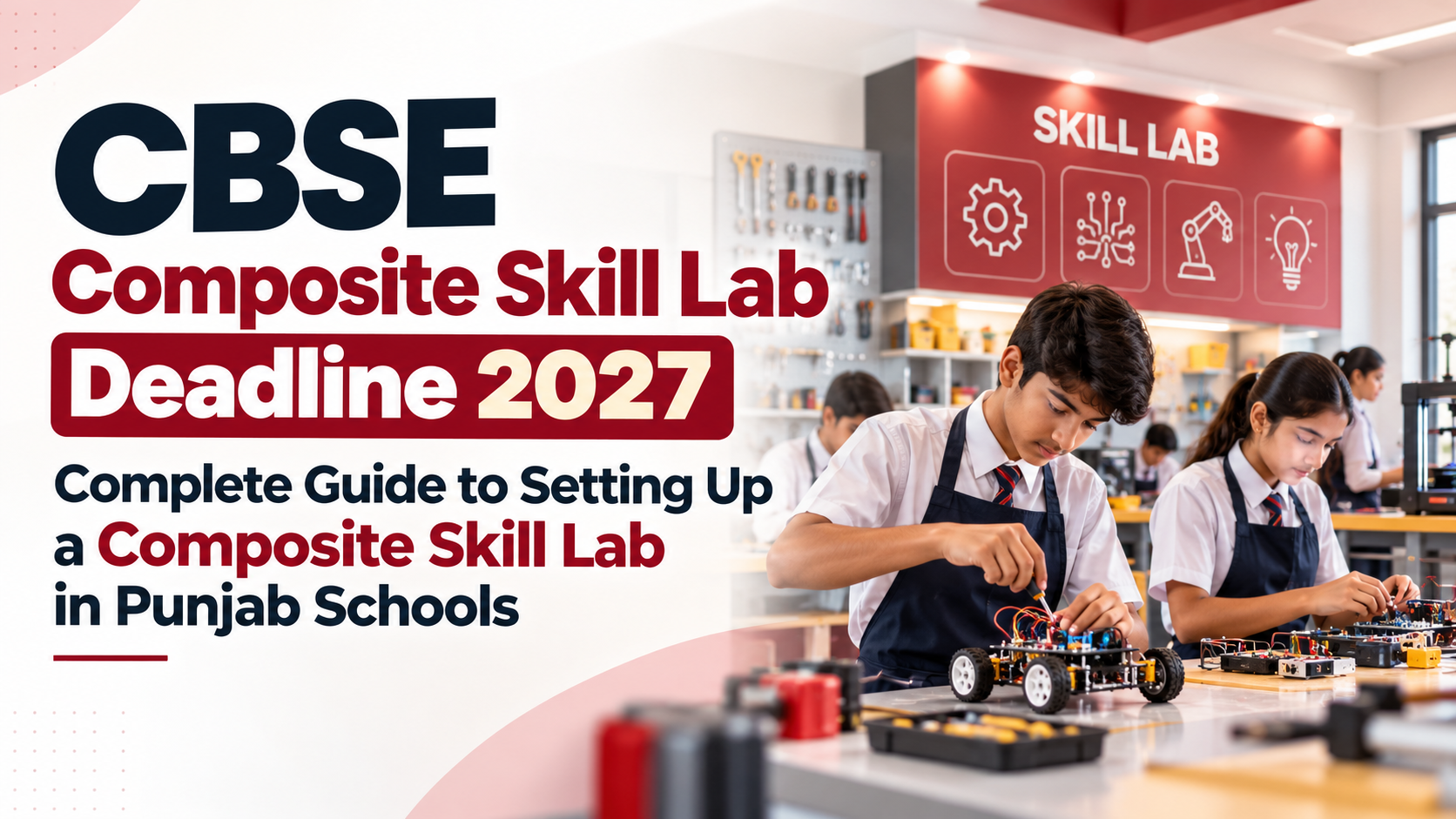
Every CBSE-affiliated school must have a fully equipped Composite Skill Lab by 22 August 2027, under CBSE Circular Skill-75/2024 and the follow-up Circular Skill-13/2026. The lab needs one room of at least 600 sq ft for Classes VI to XII, or two rooms of 400 sq ft each. For schools applying for fresh affiliation, the lab is already mandatory.
Key takeaways
- Deadline: 22 August 2027 for schools that are already affiliated. For fresh affiliation, the lab is required right now.
- Space: one room of 600 sq ft (Classes VI to XII) or two rooms of 400 sq ft each (VI to X and XI to XII), planned for batches of 25 to 40 students.
- Guidelines are out: CBSE has published a detailed booklet on layout, furniture, tools and safety. It calls the equipment lists suggestive, so you choose tools based on your skill subjects.
- Cost: CBSE's own booklet puts the setup at about Rs 3 to 6 lakh, depending on the skill subjects you choose.
- No shortcuts: an ATL lab, IT lab or Home Science lab cannot be converted into a Composite Skill Lab. A Makers Space can be, if it meets the specifications.
- For Punjab schools: about 10 months are left. Civil work, wiring, buying and teacher training all take time, so the planning should start this term.
- One partner: Class ON sets up the complete composite skill lab under one roof, from layout and stations to kits, wall design and teacher training.
Why I wrote this guide
If you run a CBSE school in Punjab, you have seen this circular. Maybe it is in a file in the office, marked "to be done". The problem is that a Composite Skill Lab is not something you can buy in one week. It needs a room, proper wiring, the right flooring, furniture, tools for each skill subject, safety equipment and a trained teacher. Done in a rush, it costs more and works less.
I'm Milan Hans, Founder and CEO of Smartway Media Pvt. Ltd. in Ludhiana. We have been working with schools since 2009, and our AI-powered school ERP, Class ON, is used by 1,000+ schools across 24+ states. Now Class ON also builds complete composite skill labs for schools.
This guide is for principals, directors and school owners in Ludhiana, Jalandhar, Amritsar, Patiala, Bathinda, Mohali and every other district of Punjab. It answers three questions in plain words:
- What exactly does CBSE want?
- By when do you need it?
- How do you set it up properly, without wasting money?
Everything about the rules in this guide comes from CBSE's own documents: the August 2024 circular, the March 2026 follow-up circular and CBSE's guidelines booklet for Composite Skill Labs. The links are in the sources at the end.
What is a Composite Skill Lab?
A Composite Skill Lab (CSL) is one shared, hands-on room where students of Classes VI to XII learn skills by doing. "Composite" means many skills in one place. In the same lab, one batch may be wiring a sensor, another may be working on a kitchen garden project, and a senior batch may be practising for a vocational subject.
It is different from a science lab, a computer lab or an ATL. A science lab supports the science syllabus. A Composite Skill Lab supports CBSE's skill education: the Kaushal Bodh projects in the middle classes and the skill subjects in Classes IX to XII.
What does CBSE Circular Skill-75/2024 say?
CBSE issued Circular No. Skill-75/2024 on 23 August 2024. It was signed by Dr. Biswajit Saha, Director (Skill Education). Here is what it says, in plain words:
|
Point |
What CBSE says |
|---|---|
|
Why |
NEP 2020 and the National Curriculum Framework for School Education make skill education part of school education from Class VI. |
|
Decision |
The lab was approved at CBSE's 139th Governing Body meeting. |
|
Size, option 1 |
One Composite Skill Lab of at least 600 sq ft for Classes VI to XII. |
|
Size, option 2 |
Two labs of at least 400 sq ft each: one for Classes VI to X and one for Classes XI and XII. |
|
New schools |
For fresh affiliation, a Composite Skill Lab with all necessary equipment and machinery is mandatory. |
|
Existing schools |
Already-affiliated schools must set up the lab within three years of the circular. |
|
Skill subjects |
Schools that offer no skill subject should start at least one. Schools that already offer skill subjects should add more. |
What changed in March 2026?
The 2024 circular said that details about setup and materials would come later. They have now come. On 20 March 2026, CBSE issued Circular No. Skill-13/2026, titled "Guidelines for Establishment of Composite Skill Labs in CBSE schools". It does three things:
- It shares CBSE's guidelines booklet for Composite Skill Labs, covering infrastructure, tool specifications, safety norms and an implementation plan.
- It states the deadline clearly: existing schools must set up the lab with all necessary equipment and machinery by 22 August 2027.
- It says the tool and equipment lists are suggestive. Schools can adopt them based on their readiness and needs.
What is the exact deadline for the CBSE Composite Skill Lab?
The last date for already-affiliated CBSE schools is 22 August 2027. For a school applying for fresh affiliation, there is no waiting period: the lab must be ready with the application.
|
Date |
What it means for your school |
|---|---|
|
23 August 2024 |
Circular Skill-75/2024 issued. The three-year window starts. |
|
10 January 2025 |
Circular Skill-01/2025 reminds schools of the three-year window and lists CBSE's skill subjects. |
|
20 March 2026 |
Circular Skill-13/2026 shares the full guidelines and confirms the deadline. |
|
April 2027 |
Session 2027-28 begins. The smart target is to have the lab running in the timetable by then. |
|
22 August 2027 |
Last date for existing CBSE schools to have a fully equipped lab. |
My honest advice: do not plan for 22 August 2027. Plan for April 2027. If the lab is ready when the new session starts, it goes into the timetable from day one and your teachers get a full year of practice before any inspection.
Does this apply to every school in Punjab?
|
Type of school |
What applies |
|---|---|
|
New school applying for CBSE affiliation |
Lab is mandatory at the time of applying. |
|
Existing CBSE school up to Class XII |
Lab must be ready by 22 August 2027. |
|
Existing CBSE school up to Class X |
The 400 sq ft lab for Classes VI to X is the natural fit. Confirm the details with your CBSE Regional Office. |
|
PSEB, CISCE, IB or Cambridge school |
This circular applies only to CBSE schools. |
What will students learn in the Composite Skill Lab?
The lab is built around what CBSE expects at each stage. This is the part most schools skip, and it is the reason many labs end up as a room full of kits that nobody uses.
|
Stage |
What students do in the lab |
|---|---|
|
Classes VI to VIII |
Kaushal Bodh projects: three projects in each class, one from each "form of work". That makes nine projects over three years. |
|
Classes IX and X |
Six vocations over two years, two from each form of work, across skill sectors. CBSE listed 22 skill subjects for these classes in January 2025. |
|
Classes XI and XII |
Choice-based vocational skill subjects at NSQF level 3 to 4 or above. CBSE listed 43 skill subjects for these classes in January 2025. |
CBSE's guidelines also ask schools to give 110 hours of skill education every year in the timetable for Classes VI to X. So the lab is a room your timetable depends on, not a showpiece.
Kaushal Bodh project examples for Classes VI to VIII
|
Form of work |
Example projects from CBSE's guidelines |
|---|---|
|
Work with life forms |
School kitchen garden, plant nursery, hydroponics, biodiversity register, school habitat garden, caring for farm animals |
|
Work with machines and materials |
Maker skills, animation and games, AI assistant, home automation, working with wood and bamboo, tie and dye |
|
Work in human services |
School museum, cooking without fire, storytime with puppets, family health handbook, water audit, creating advertisements |
What equipment does a CBSE Composite Skill Lab need?
CBSE's guidelines give a suggestive tool list for 11 sectors, with quantities for a class of 40. You do not need all 11. You need the tools for the skill subjects your school actually offers.
|
Sector |
Sample tools from CBSE's suggestive list |
|---|---|
|
Agriculture and Gardening |
Thermometer, hygrometer, budding knives, drip irrigation kit, soil testing kit, spray pump, hand tools, seeds, cocopeat, nursery bags |
|
Food Production |
Digital balance, cooking and food processing equipment, pressure cooker, stove, containers, aprons and caps |
|
Electronics and Mechatronics |
Arduino UNO, ESP32, sensors, motors, multimeters, soldering kits, hand tools, resistors, LEDs |
|
Apparel |
Sewing and fabric tools, embroidery hoops, sewing machines (optional), dyes |
|
Automotive |
Wrench and spanner sets, gauges, hydraulic ramp, engine work bench, a two-wheeler for practice |
|
Carpentry and Woodwork |
Saws, chisels, hammers, files, drills, planer, ply cutting machine |
|
IT and ITeS |
At least 20 working computers. The existing IT lab can be used for this subject. |
|
AVGC and Media |
Graphics computers, drawing tablets, microphones, cameras, green screen, free software such as Blender and GIMP |
|
Healthcare |
BP machine, glucometer, pulse oximeter, CPR mannequin, PPE kits, biomedical waste bins |
|
Beauty and Wellness |
Hair dryers, styling tools, manicure and pedicure sets, shampoo bowls, waxing heaters |
|
Retail |
Barcode scanner, billing system, display racks, shelving, signage |
For AI work, CBSE's guidelines suggest 3 to 5 desktops (Intel i7 13th gen or AMD Ryzen 7 class, 16 GB RAM, 1 TB SSD) and 3 to 5 laptops of a similar specification.
What does CBSE say about layout, furniture, flooring and power?
The room itself matters as much as the tools. CBSE's guidelines assume a 30 ft x 20 ft room (600 sq ft), which you can adjust to your actual space. They ask for a modular layout, so you can change workstations when you add new skill subjects.
The zones in the lab: a safety corner near the entrance, group working tables, a teacher's table, storage cupboards and open shelves, pegboards for tools, a projection area with an LED screen or projector, an optional sink area, and "speaking walls" with murals and labelled zones.
The room: good ventilation with windows and exhaust fans, at least two clear walls for pegboards and posters, proper wiring, lighting and fans, water and drainage where needed, two wide doors for a safe exit, and ideally an open area nearby for gardening.
|
Item |
CBSE's suggested specification |
|---|---|
|
Working tables |
Steel frame, 4 ft wide, about 30 inches high, 18 mm commercial ply top, 6 or 8 ft long, rounded edges |
|
Stools |
12 x 12 x 20 inches, steel frame, rubber levellers |
|
Teacher's desk |
Wooden, 3 ft x 2 ft, with a chair |
|
Teacher's cupboard |
Steel, 48 x 36 x 18 inches, with lock |
|
Wall storage cupboards |
Steel, 78 x 36 x 24 inches, four adjustable shelves |
|
Tool pegboard |
4 ft x 3 ft, 18 mm waterproof plywood |
|
Safety rack |
Iron, 48 x 48 x 18 inches, three shelves |
|
Flooring |
Concrete or rubber mats. Avoid vitrified tiles and stone. Anti-slip near water, anti-static mats for electronics. |
|
Power |
15 A and 5 A sockets, preferably on all walls, cable trays under desks, surge protectors and UPS, emergency stop buttons on machines |
What safety equipment is required?
For a batch of 40 students, CBSE's guidelines list this basic safety kit:
|
Safety item |
Quantity |
|---|---|
|
ABC fire extinguisher, 2 kg |
1 |
|
First aid box |
1 |
|
Gloves |
15 |
|
Aprons |
15 |
|
Rubber matting |
8 |
|
Sand buckets, 10 litre |
2 |
On top of the kit, CBSE expects do's and don'ts and emergency numbers on display, PPE during practicals, sharp tools locked on pegboards, labelled storage, supervision during every practical, and regular fire and evacuation drills.
How much does a Composite Skill Lab cost?
CBSE's own guidelines say: "The setting up of the CSL may cost about Rs. 3-6 lakhs depending on the skill subjects chosen." The cost depends on the subjects, the room size and the type of furniture. CBSE also says this costing is only suggestive and that schools may want to invest more in branded equipment.
When you compare quotes, ask every vendor to show clearly what the quote covers: civil work, wiring, flooring, furniture, tools, computers, wall design, installation and teacher training. Two quotes that look similar often cover very different things.
Can we convert our ATL or computer lab into a Composite Skill Lab?
No. CBSE's guidelines are clear on this.
|
Existing lab |
Can it become the Composite Skill Lab? |
|---|---|
|
Atal Tinkering Lab (ATL) |
No, because it is a government-funded project |
|
IT or computer lab |
No, though it can still be used for the IT skill subject |
|
Home Science lab |
No, because it serves Classes XI and XII |
|
Single-sector lab funded by the government or CBSE |
No |
|
Makers Space |
Yes, if it meets the specifications |
|
School garden |
It can be used for agriculture work, but the tools must be kept in the Composite Skill Lab |
Who will teach in the lab?
CBSE wants teachers identified or hired specifically for skill education, and trained in the curriculum and the practical side. Where trained teachers are not available, locally trained resource persons can teach, coordinated by a regular teacher. The guidelines also suggest a skill coordinator for industry visits and guest experts, and a lab in-charge for supervision, tool upkeep and stock records.
CBSE has said it is appointing District Skill Coordinators to support schools. Its training programmes for principals and skill teachers are free and count towards the 50 hours of yearly professional development.
How to set up a Composite Skill Lab in a Punjab school: step by step
Step 1: Pick the right room
Mark one room of at least 600 sq ft, or two rooms of 400 sq ft each. Check that it has two clear walls for pegboards, good windows, space for two wide doors and, ideally, open ground nearby for gardening work. A ground floor room is the practical choice, because heavy equipment is easier to move and the exit is quicker in an emergency.
Step 2: Choose skill subjects first, tools second
This is the most important step. Decide which projects and skill subjects you will run for Classes VI to VIII, IX and X, and XI and XII. Only then make the tool list. Base the choice on three things: what your students are interested in, which teachers you have, and which industries are near your school.
Step 3: Prepare the room for Punjab's weather and power
Punjab summers regularly cross 40°C, and many schools face power cuts in peak season. So the ventilation and exhaust fans that CBSE asks for are not optional here, and the UPS and surge protection matter even more. Many older school buildings in Punjab have vitrified tile floors. CBSE says to avoid them in this lab, so plan for rubber mats or concrete.
Step 4: Plan the layout and zones
Draw the room: safety corner at the entrance, group working tables in the middle, pegboards and storage on the walls, teacher's table and projection area at the front, and a sink area if you run food or agriculture work. Keep the layout modular, so you can add new subjects next year without breaking walls.
Step 5: Get furniture and storage made to CBSE's specification
Working tables, stools, cupboards, pegboards and the safety rack all have suggested sizes in CBSE's guidelines (see the table above). Local carpenters can make some of this, but make sure they follow the specification, especially the 18 mm ply tops and rounded edges.
Step 6: Buy the tools, kits and safety equipment
Buy the tools for the subjects you chose in Step 2, plus the safety kit. Ask for a stock list with model numbers and quantities, and check every item at delivery.
Step 7: Train your teachers
Name a skill teacher, a lab in-charge and a skill coordinator. Get them trained on both the curriculum and the equipment before the lab opens. A lab without a confident teacher stays locked.
Step 8: Put the lab into the timetable
CBSE expects 110 hours of skill education a year for Classes VI to X. Block those periods in the timetable before the session starts, and record skill marks and project work in the report card.
Step 9: Connect with local industry
CBSE's guidelines encourage industry visits, guest experts and internships. Punjab has strong local industries for this (see the table below).
Step 10: Keep your records ready
Maintain a stock register, a safety drill log, the lab timetable and dated photos of the lab in use. If anyone asks for proof of compliance, you will have it in one file.
Which skill subjects suit schools in different Punjab cities?
Pick subjects that match the industries around your school. Students get real industry visits, and your skill coordinator finds guest experts easily.
|
City or region |
Local industry |
Skill sectors that fit |
|---|---|---|
|
Ludhiana |
Hosiery and knitwear, bicycles, auto parts, machine tools |
Apparel, Automotive, Electronics and Mechatronics |
|
Jalandhar |
Sports goods, hand tools |
Carpentry and Woodwork, Electronics and Mechatronics, Retail |
|
Amritsar |
Tourism, hospitality, food |
Food Production, Tourism and Hospitality, Retail |
|
Mohali |
IT and electronics companies |
IT and ITeS, AI, AVGC and Media |
|
Patiala, Bathinda, Sangrur and the Malwa belt |
Agriculture and food processing |
Agriculture and Gardening, Food Production |
|
Every district |
Hospitals, shops, salons |
Healthcare, Retail, Beauty and Wellness |
Punjab is an agricultural state, so the "work with life forms" projects come naturally here: kitchen garden, plant nursery, hydroponics, drip irrigation and soil testing. The water audit project from CBSE's Kaushal Bodh list is also very relevant for Punjab, where falling groundwater is a real concern.
A 10-month plan to meet the 22 August 2027 deadline
|
When |
What to finish |
|---|---|
|
October to November 2026 |
Room audit, skill subjects chosen, budget approved, setup partner selected |
|
December 2026 |
Civil work, wiring, sockets, flooring, ventilation |
|
January 2027 |
Furniture, storage, pegboards, safety corner, wall design |
|
February to March 2027 |
Tools and kits installed, teachers trained |
|
April 2027 |
Lab in the timetable from the first week of session 2027-28 |
|
May to August 2027 |
Lab in regular use. Use the summer vacation to fix any gaps. Records ready well before 22 August 2027. |
Composite Skill Lab checklist for Punjab schools
- Room of 600 sq ft, or two rooms of 400 sq ft, marked for the lab
- Two wide doors, good windows and exhaust fans
- 15 A and 5 A sockets on the walls, cable trays, UPS and surge protection
- Concrete or rubber-mat flooring, not slippery tiles
- Skill projects and subjects chosen for Classes VI to VIII, IX and X, and XI and XII
- Tools for every chosen subject, based on CBSE's suggestive list
- Working tables, stools, cupboards, pegboards and safety rack made to specification
- Safety corner with fire extinguisher, first aid box, sand buckets, gloves and aprons
- Projector or interactive panel in the projection area
- Do's and don'ts and emergency numbers on the wall
- Skill teacher, lab in-charge and skill coordinator named and trained
- Lab periods in the timetable (110 hours a year for Classes VI to X)
- Stock register, safety drill log and dated photos maintained
How does Class ON set up a complete Composite Skill Lab under one roof?
Most schools that start this work end up dealing with five or six vendors: a carpenter for furniture, an electrician, a robotics company, a computer dealer, a printer for wall posters and a separate trainer. When something does not fit, every vendor blames the other. The deadline slips, and the principal spends months chasing people.
Class ON sets up the complete Composite Skill Lab under one roof. One team plans the room, installs the stations, designs the walls and trains your teachers. Class ON is a product of Smartway Media Pvt. Ltd., Ludhiana, which has been working with schools since 2009. Our school ERP is used by 1,000+ schools across 24+ states, and the lab work is built on the same understanding of how schools actually run.
What comes with a Class ON Composite Skill Lab
|
Station |
What your school gets |
|---|---|
|
Lab planning and layout |
A layout for one 600 sq ft lab or two 400 sq ft labs, with the zones CBSE asks for |
|
Coding and Robotics Station |
Neobot AI and Robotics kits with dual IR sensors, motor driver, servo control and plug-and-play ports for ultrasonic, line tracking, light, temperature, humidity, gas, RFID, Bluetooth, Wi-Fi and camera modules. Students program them with block coding and Python in the Code4AI app, and more than 100 projects are possible. |
|
CraftiQ Addons |
Precision-cut MDF structures that turn Neobot into working models: smart traffic light, password protected box, smart dustbin, smart lamp, electronic guitar, IoT home automation, reaction game, rover car and touchless hand sanitizer |
|
Electronics and IoT Station |
Sensor add-ons: servo motors, resistor box, ultrasonic, LDR, soil moisture, rain drop, flame and smoke sensors, keypad, potentiometer, breadboards, LEDs and jumper wires |
|
Tools and Soldering Station |
Soldering station with adjustable temperature (200°C to 450°C), and a pegboard with pliers, wire stripper, screwdrivers, precision screwdrivers, Allen keys, hacksaw, hammer, cutter, tweezers, measuring tape, helping hand with magnifier, cutting mat and labelled storage bins |
|
Drone Innovation Station |
10 DIY drones that students build, code and fly, with projects like aerial survey, obstacle avoidance, follow-me and auto take-off and landing |
|
3D Printing and Prototyping Station |
A 3D printer with multi-colour PLA filament, for prototypes, models and working parts |
|
Aeromodelling Station |
An aeromodel plane and a DIY airplane kit with pre-cut wooden parts, DC motor, propeller and landing gear |
|
Space Technology Station |
A 70 mm telescope with 20 mm, 12.5 mm and 6 mm eyepieces, a 2x Barlow lens and a star pointer finder scope |
|
3D Printed Robotic Hand |
Servo-driven fingers, programmable with Arduino or Scratch, for robotics and mechanics projects |
|
AI-Powered Humanoid Teaching Robot |
A humanoid robot with AI conversation, facial expressions and head, arm and hand movement, which makes AI real for students and visiting parents |
|
65-inch Smart Interactive Panel |
4K display, 40-point touch, Android, wireless screen sharing and built-in speakers for the projection area |
|
Virtual Reality Station |
Two VR headsets for virtual field trips, STEM simulations, the human body and space exploration |
|
Robotics Soccer Arena |
An arena where students build, program and compete with their own robots |
|
Lab decoration |
Wall vinyl, educational posters, 3D hanging planets, rockets and robots, thematic wall graphics, lab branding, signage and learning corners, with complete installation |
|
Teacher training and curriculum |
Training on the installed equipment and a practical, activity-based curriculum aligned with NEP 2020 and NCF 2023, with a small book for each class |
How Class ON maps to what CBSE asks for
|
CBSE asks for |
What Class ON provides |
|---|---|
|
Electronics and Mechatronics tools: boards, sensors, motors, soldering kits, hand tools |
Neobot kits, IoT sensor add-ons, soldering station and tools station |
|
Kaushal Bodh projects like maker skills, home automation and AI assistant |
CraftiQ project builds, IoT home automation and AI projects on Neobot |
|
Pegboards for tools |
Tools station pegboard with every tool labelled |
|
Projection area with an LED screen or projector |
65-inch smart interactive panel |
|
Speaking walls, murals and labelled zones |
Lab decoration, signage and learning corners |
|
Modular layout with zones |
Lab planning for 600 sq ft or two 400 sq ft rooms |
|
Trained teachers |
Teacher training on the exact equipment installed |
|
Tools for the other skill subjects your school picks |
Planned and set up by the same Class ON team, as part of one project |
Why one partner works better than five vendors
- One plan, one deadline: one team owns the whole lab, so the 22 August 2027 date does not depend on five separate people.
- Everything fits: the tables suit the kits, and the sockets are where the soldering station sits.
- Training matches the equipment: your teachers learn on the exact kits they will use with students.
- The lab looks finished: a well-built lab is one of the strongest things you can show parents during admission season.
If your school already uses the Class ON ERP
The lab fits into the system you already use. Lab periods go into the same timetable, and skill subject marks and project work go into the same report cards and holistic progress card. Parents see updates in the Class ON parent app. The Class ON ERP works for CBSE, CISCE, State Board, IB and Cambridge schools, so group schools with mixed boards can run everything from one place.
Want a lab plan for your school? Call Class ON at 90237-90237, email [email protected] or book a demo. Our team will look at your room and your skill subjects and give you a clear plan to finish well before the deadline.
8 mistakes to avoid while setting up a Composite Skill Lab
- Waiting until 2027. Civil work, furniture, delivery and training together take months. Schools that start in May 2027 will be rushing, paying more and settling for less.
- Treating one robotics kit as the whole lab. A box of kits is not a Composite Skill Lab. CBSE wants a planned room with zones, furniture, safety equipment, tools for your skill subjects and a trained teacher.
- Converting the ATL or computer lab. CBSE's guidelines say clearly that an ATL, IT lab or Home Science lab cannot be converted. Plan a separate room.
- Buying tools before choosing subjects. Choose the projects and skill subjects first. Otherwise you pay for tools no class will use.
- Ignoring the room basics. Slippery tiles, too few sockets and poor ventilation make a lab unsafe and uncomfortable, especially in a Punjab summer.
- Skipping the safety corner. Fire extinguisher, first aid box, sand buckets, gloves and aprons are part of CBSE's guidelines, not extras.
- No trained teacher. A lab without a confident teacher stays locked. Train your skill teacher and lab in-charge before the lab opens.
- Keeping the lab out of the timetable. If lab periods are not in the timetable, the lab will not be used. Block the 110 hours for Classes VI to X before the session starts.
Conclusion: start this term, not next year
CBSE gave schools three years. More than two of those years have already passed. The guidelines are out, the deadline is fixed at 22 August 2027, and the lab must be fully equipped, not half done.
For Punjab schools, my advice is simple. This month, mark the room and choose your skill subjects. By December, finish the civil and electrical work. By April 2027, have the lab running in your timetable. Then you have a full session to settle in, and a lab you are proud to show parents.
If you want one partner to handle the whole job, Class ON sets up the complete Composite Skill Lab under one roof, from planning and stations to wall design and teacher training. Call 90237-90237 or book a demo, and we will share a plan made for your school.
Frequently asked questions
What is a CBSE Composite Skill Lab?
A Composite Skill Lab is one shared, hands-on room where students of Classes VI to XII learn practical skills across many sectors, such as electronics, agriculture, food production, IT and healthcare. CBSE made it compulsory through Circular Skill-75/2024, in line with NEP 2020, which makes skill education part of school from Class VI.
What is the last date to set up a Composite Skill Lab in CBSE schools?
The last date for already-affiliated CBSE schools is 22 August 2027, as confirmed in CBSE Circular Skill-13/2026 dated 20 March 2026. Schools applying for fresh affiliation must have the lab, with all necessary equipment and machinery, at the time of applying.
What size should a CBSE Composite Skill Lab be?
CBSE allows two options. A school can build one lab of at least 600 sq ft for Classes VI to XII, or two labs of at least 400 sq ft each, one for Classes VI to X and one for Classes XI and XII. The lab should seat a batch of 25 to 40 students safely.
How much does a Composite Skill Lab cost?
CBSE's guidelines say a Composite Skill Lab may cost about Rs 3 to 6 lakh, depending on the skill subjects chosen. CBSE calls this costing suggestive. The final cost depends on your subjects, room size, furniture and whether you choose branded equipment, so compare quotes line by line.
Is a Composite Skill Lab mandatory for new CBSE affiliation?
Yes. Under Circular Skill-75/2024, a Composite Skill Lab with all necessary equipment and machinery is mandatory for every school applying for fresh CBSE affiliation. Existing schools get time until 22 August 2027.
Can we convert our Atal Tinkering Lab into a Composite Skill Lab?
No. CBSE's guidelines say an ATL cannot be converted into a Composite Skill Lab because it is a government-funded project. An IT lab or Home Science lab cannot be converted either. A Makers Space can be converted if it meets CBSE's specifications.
What equipment does a Composite Skill Lab need?
It needs working tables, stools, storage cupboards, tool pegboards, a safety rack, a projector or LED screen, a safety kit, and the tools for the skill subjects your school offers. CBSE's guidelines give a suggestive tool list for 11 sectors, from agriculture and electronics to healthcare and retail.
Which skill subjects should a school in Punjab choose?
Choose subjects that match your students, your teachers and the industries near your school. Ludhiana schools can look at apparel, automotive and electronics. Mohali suits IT and AI. Amritsar suits food production and hospitality. Schools in the Malwa belt can build strong agriculture and food production projects.
Do schools pay CBSE a fee for skill subjects?
No. CBSE's Circular Skill-01/2025 says schools pay no fee to CBSE for any skill module, skill subject or certificate download. Schools also do not need separate permission from CBSE to introduce skill subjects.
Who can set up a complete Composite Skill Lab in Punjab?
Class ON, a product of Smartway Media Pvt. Ltd., Ludhiana, sets up the complete Composite Skill Lab under one roof: planning, coding and robotics, electronics and IoT, tools and soldering, drones, 3D printing, wall design and teacher training. Class ON works with 1,000+ schools across 24+ states. Call 90237-90237.
Composite skill lab kya hai aur kab tak banana hai?
Composite skill lab ek aisa lab hai jahan Class VI se XII tak ke bachche haath se kaam karke skills seekhte hain. CBSE ke circular ke hisaab se har affiliated school ko 22 August 2027 tak 600 sq ft ka lab (ya 400 sq ft ke do lab) poori equipment ke saath banana hai. Naye affiliation ke liye yeh abhi se zaroori hai.
Milan Hans
Founder & CEOMilan Hans, also known as Milan Singh Hans, is an Indian entrepreneur, director, admission booster coach, and businessperson based in Ludhiana, a large industrial city in the Punjab. He is the president of the Malout Helping Foundation, an NGO. Milan Hans is the creator and CEO of Class ON, an application that feeds quick communication to parents and students. He has been awarded many notable awards, such as the Youth Icon Award 2015, the Excellent Work Award 2012, and the Innovation in Education & Technology Award 2019.