


 Milan Hans
-November 23, 2026
To increase school admissions, run December to February as one 90-day campaign. Use the first 30 days to fix your Google listing, campus and follow-up system. Use the next 30 to attract parents through referrals, reels and a Parent Preview Day. Use the last 30 to convert, with fast replies, demo classes and daily follow-up.
Key takeaways
- The real season is December to March. Bigger schools start promoting in October and November, so the most decisive parents choose early. Start your preparation now.
- Work backwards from your target. With average follow-up, 20–30% of enquiries become admissions. 100 admissions need roughly 334 to 500 enquiries.
- Speed wins. Send an automatic WhatsApp reply the moment an enquiry lands, and call within 30 minutes to book a campus visit.
- Your parents are your cheapest channel. At a well-run PTM, parents attending × 1.5 is the number of referral names you should collect.
- Cap your cost. One admission should not cost more than one month's fee, roughly 8–10% of the annual fee.
- Count your people. One person can handle about 25–35 new enquiry calls a day. Above that, you need a second person, not more pressure.
- Track every lead. A Haryana school moved from 5–10 admissions per 100 leads to 30–35 once it followed up daily through a CRM.
Why are admissions won or lost in just 90 days?
Every February, my phone rings with the same call. A school owner, frustrated: "Sir, leads toh aa rahi hain, par convert nahi ho rahi. Market down hai is saal." (The leads are coming, but they're not converting. The market is down this year.)
I don't argue. I ask one question: how many enquiries came in last month, and how many campus tours did your team do? Around 300 enquiries, comes the answer, and ten or twelve tours a day in the busy weeks. Then I ask who was supposed to handle all of that. The answer is almost always one person.
The market was fine. The leads were fine. The plan was missing.
Most admissions for the new session are decided between December and March. The bigger schools in your city already know this, and they start promoting in October and November. By the time a school wakes up with a January campaign, the most decisive parents in the area have already chosen.
So this year, don't run a campaign that reacts to February. Run one that is planned before 1 December. This guide turns the strategies from my book, School Growth Blueprint, into a 90-day plan for the 2027-28 session, from 1 December 2026 to 28 February 2027, with a short preparation week before it and a March follow-up push after it. Every story in it is real, and as in the book, no school is named.
It works for CBSE, CISCE, State Board, IB and Cambridge schools alike, because parents choose schools the same way everywhere: by trust.
Week 0 (before 1 December): what numbers should you know first?
Before you spend a single rupee, answer four questions honestly:
- How many students did you have three years ago, and how many today?
- How many enquiries came in last season, and how many became admissions?
- Which advertising channel actually produced students?
- How many seats are empty right now?
If two of these made you pause, you are not alone. Almost nobody tracks them. But without them, every growth decision is a guess.
What good looks like: admission benchmarks from the field
|
Number |
Healthy benchmark |
|---|---|
|
Enquiries per season |
Around 100–150 for a small school; 400–500 for a bigger school |
|
Enquiry-to-admission conversion |
20–30% with average follow-up; 50–60% with a truly skilled counsellor |
|
Demo class attendance |
5–10% more children than the seats you need to fill |
|
Referral names from a PTM |
Parents attending × 1.5 |
|
Cost of one admission |
Not more than one month's fee, roughly 8–10% of the annual fee |
Work backwards from your target
Decide how many admissions you need, then calculate the enquiries that target demands.
|
Admissions you need |
Enquiries needed at 20% |
Enquiries needed at 30% |
|---|---|---|
|
20 |
100 |
67 |
|
60 |
300 |
200 |
|
100 |
500 |
334 |
If you need 100 admissions but your school generates only 150 enquiries a season, your follow-up is not the main problem. Not enough parents are hearing about you, and the first 60 days of this plan must fix that.
Do the capacity check now, not in February
One person, working properly, can handle about 25–35 new enquiry calls a day, 15–20 follow-up calls on top, and 8–12 campus tours in a peak week. Write down what your school asked one person to do last season and compare. If your numbers are bigger, you don't need a better counsellor. You need a second one, hired before December, not in a panic in February.
One more rule for Week 0: a part-time teacher handling admissions "along with her classes" is not enough. Give the season one dedicated owner, someone who can sit with a parent, understand what they need, and work on social media when no parent is visiting.
The 90-day admission plan at a glance
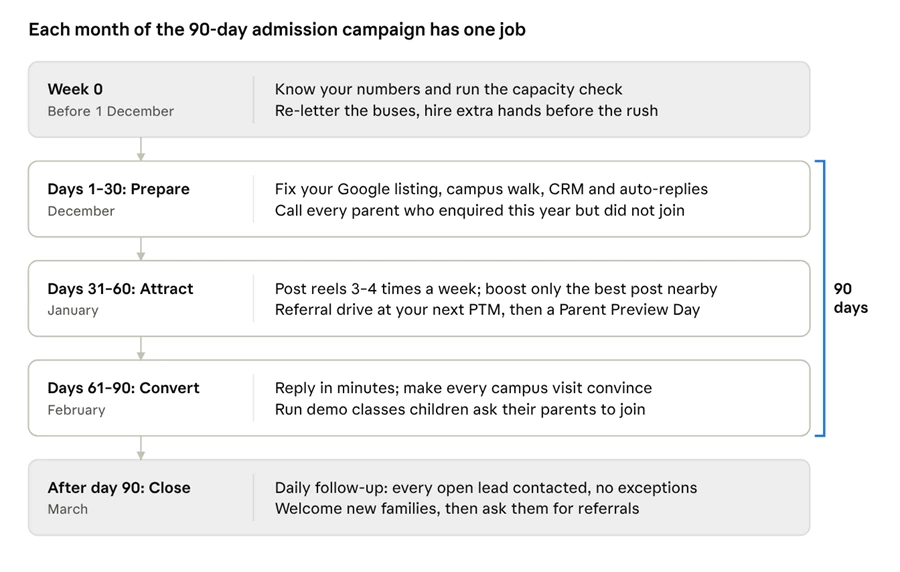
The 90-day admission campaign for 2027-28 · Week 0, three 30-day phases, March close
Think of the plan as three jobs in a row: get ready, get noticed, get the yes. Each phase depends on the one before it. A beautiful reel cannot save a parent's enquiry that nobody follows up.
Days 1–30 (December): how do you prepare your school for admission season?
1. Fix your digital front desk
Before a parent calls you or visits, they search for you on Google. In my own visits I keep finding the same problems: a wrong map pin, an old phone number, reviews with no reply, and photos uploaded years ago by some parent. By my estimate, well over 80% of Indian schools have either ignored their Google Business Profile or never set it up properly.
In 2022, I sat with a school owner in a tier-2 city who believed his area was "too small" for a good school. His Google listing had the wrong phone number, and the map pin pointed to a hospital. We fixed everything within two weeks. Within three months, his enquiry calls doubled, and by his own rough count, about one in five admissions now starts from Google.
This month:
- Claim the listing yourself, and correct the phone number, website, timings and map pin.
- Upload recent, professional photos and short videos of your campus and activities. A 360° virtual tour is the strongest trust-builder if the budget allows.
- Reply to every review, good or bad, and ask for new ones at the reception QR code and from happy parents.
- Claim your listing on education directories too, such as ClassHud, which is free to list on.
2. Walk the parent's route
A visiting parent never sees your whole campus. They walk one route: gate, reception, the corridor to the Principal's office, one or two classrooms, perhaps a washroom, and back. Walk that route yourself with a notebook, and spend your branding money there first. For a mid-size school, a one-time spend of roughly ₹50,000 to ₹1,00,000 on paint, murals, greenery and the reception usually changes how the campus feels.
Then fix the people a parent meets before the Principal:
- The guard: one warm line, clear directions, no mobile phone in hand, and every visitor recorded digitally instead of in a register.
- The phone: every call answered with the school's name, the person's own name and "How can I help you?"
- Hospitality: offer water, tea or coffee to every visitor. It matters more than most schools think.
- ID cards: every staff member a parent meets should wear one. (See our guide to school ID cards.)
3. Turn your buses into billboards
Your buses pass the same parents twice a day. Wash them weekly, and paste a clean flex on the back with your school name, your two strongest features and one mobile number in big, bold digits. Most schools print the number so small that nobody in the car behind can read it.
4. Set up the follow-up system before the leads arrive
- Put every enquiry, from calls, walk-ins, WhatsApp, the website, social media and referrals, into one CRM, tagged with its source.
- Switch on an automatic WhatsApp reply that sends your brochure, fee range, tour timings and location pin instantly, even at 11 PM.
- Make one person responsible for the follow-up list every single day.
- Get a simple yearly photo and video consent from parents now, so the content team can shoot freely in January.
5. December's most important action
Call every parent who enquired this year but did not join. They already know your name. Many simply never heard from you again. A warm, personal call in December, with an invitation to visit, is the cheapest admission you will get all season.
Days 31–60 (January): how do you attract more parents to your school?
By January, your listing is fixed, your campus is ready, and your follow-up system is waiting. Now you need more parents to hear about you.
1. Show the students you already have
Around 2022, a school in Ludhiana had only 100–150 students, and the number was falling. A close friend of mine joined as principal. We didn't start with ads. First the campus got fresh paint and murals, then a new logo and fresh social media pages. Then came the real shift: the school turned the students it already had into its ambassadors. Daily activities, teachers and progress were posted professionally and consistently, with only a small boost behind posts that were already doing well. Within two years, that school had grown to around 500 students.
The weekly routine that works:
- Post 3–4 times a week, every week, not in bursts.
- From each event, post only the best 5–6 photos, edited, never 30 raw ones.
- Shoot a 15–30 second reel for every major event.
- Make one teacher and one student photographer clearly responsible.
- Cross-post the same content on Instagram, Facebook and YouTube Shorts. Facebook still reaches many older decision-makers in the family; Instagram and Shorts reach younger parents and spread faster.
2. Make reels that travel
The strongest school pages are not the ones with the biggest budgets. A village school in Mansa, Punjab, crossed 70,000 Instagram followers by October 2026 without spending a rupee on promotion. Its formula: one simple, useful video at a time, often a small science experiment, explained by students in Punjabi so anyone in the community can follow it. Most years, that school puts up an "Admission Closed" board.
Three rules for every reel:
- The first three seconds must make someone curious. Build the hook before anything else.
- Give something real, not a sales pitch. A useful idea gets shared; an advertisement gets skipped.
- Speak the language your parents speak at home, in simple sentences.
And one rule you can never skip: never film or photograph a child without the parent's consent.
3. Make posters with one message
A poster listing fifteen features (AC rooms, CCTV, smart classes, RO water) says nothing, because every school nearby claims the same list. Pick two or three strengths that only your school can honestly claim, put one large headline on top, use your fixed school colours, and end with one clear next step: a number, a QR code or "Visit us this week".
4. Boost only what is already working
You don't need a big ad budget. On Facebook and Instagram, boost your single best-performing post, such as your strongest reel or a clean campus photo with an admission-open message, to parents within 3–5 km of your school, for as little as ₹50–100 a day during the season. Never boost weak content. A small budget behind a strong post multiplies its reach; the same budget behind a weak post only wastes money faster.
5. Give parents something they can see
Parents today want proof, not promises: practical learning, confident children and visible facilities. An AI & Robotics Lab where children build robots and write code is something a parent sees on a campus visit and a child talks about at dinner.
6. January's most important action
Host a Parent Preview Day. Invite your entire enquiry list and the referral names from your PTM. Let your Principal or Director address them personally, walk them through the campus, let them meet teachers, and treat every family as a guest. A parent who hears the school's vision from its leader feels the difference that no brochure can explain.
Days 61–90 (February): how do you convert enquiries into admissions?
February is when most schools lose the admissions they already earned. The enquiry came, the parent was interested, and then nobody called back on the right day.
1. Reply in minutes, not days
When a parent messages three schools at night, the one that replies first is remembered first.
|
When |
What happens |
|---|---|
|
Immediately |
An automatic WhatsApp reply with your brochure, fee range, tour timings and location pin, even at 11 PM |
|
Within 30 minutes (or next morning for a late-night message) |
A phone call with one goal only: booking a campus visit |
|
Same day as the visit |
A thank-you message asking the parent to rate their visit. Parents are polite in person; a private rating tells you the truth. |
2. Follow up by temperature, not by memory
Around 2022, a school in Haryana told me: "Sir, we get plenty of leads, but by the time we follow up, the child is admitted somewhere else." Their system was a manual register, and one day a week, Saturday, was set aside to call everyone in it. A parent who missed that Saturday call waited another full week. Out of every 100 leads, they were managing only 5 to 10 admissions.
They started using Class ON CRM properly, every day. The same 100 leads began turning into 30 to 35 admissions, and the number has kept rising every year since.
The rhythm that works:
|
Lead |
How you recognise it |
Follow-up rhythm |
|---|---|---|
|
Hot |
Asks detailed questions, says "we'll do the admission soon" |
Call 2–3 times a week, with school updates on WhatsApp in between |
|
Warm |
Interested, but not decided or urgent |
Call about twice a week |
|
Cold |
Casual enquiry, no clear intent yet |
Call once a week to stay on their radar |
Call after 10 AM. If there is no answer, try again after 4 PM. If it is still not picked up, send a short WhatsApp message with your school's name, so the parent knows exactly who called. And remember that a lead's temperature changes in both directions, depending on how well you communicate.
3. Make every campus visit convince
The visit is where interest becomes a decision. Plan the route, the people and the 25–35 minutes in advance: a warm welcome at the gate, water or tea at reception, a short walk through classrooms and labs, a meeting with the Principal, and a clear next step before the parent leaves. Never let a parent walk out without knowing what happens next.
4. February's most important action
Run demo classes engaging enough that children ask their parents to enrol. Invite 5–10% more children than the seats you need to fill, because not everyone turns up.
The power of letting the child decide is real. A school in Malout opened just three years ago with around 400 students on Class ON and has since crossed 1,000. For new preschool children, the first three months are completely free, and teachers treat every new child with real warmth, with the latest toys, books and videos. After three happy months, the child does not want to go anywhere else, and parents pay the normal fees gladly. One honest caution: an offer like this works only when the experience is truly outstanding. Fix the experience first, then make the offer.
How do you get admission referrals from existing parents? The Referral Flywheel
If I could give a school leader only one strategy for this season, it would be this one. Parents don't fully trust advertisements. They trust other parents.
I call it The Referral Flywheel. Happy parents give you names. Your team calls those names, and some become admissions. Those new families become happy parents, and at the next PTM they give you names of their own. Every turn makes the next one easier, and none of it needs an ad budget.
The real result
A school with around 500 students had satisfied parents but slowing admissions. Instead of spending more on ads, we changed how it ran one Parent-Teacher Meeting. About 400 parents attended. Those 400 parents gave 600 to 650 names, and around 60 of those families took admission, roughly 10%, with no extra marketing budget.
Ten per cent is the floor, not the ceiling. A name that comes with a friend's recommendation starts warm from the very first call. With a counsellor who guides parents well, I have seen this strategy bring in up to 50%.
A 1,500-student school in Ludhiana once watched my YouTube video on this method the day before its own PTM. The owner applied it exactly, the team called the referrals the same day, and he called me afterwards: "Milan ji, your video worked wonders." Admissions went up by 10 in a single day.
How to run a referral PTM
- Set the target before the PTM: parents expected to attend × 1.5 = names to collect. A school expecting 240 parents should aim for about 350 names.
- Change the mood: a warm welcome, proper hospitality, and teachers who lead with appreciation and growth, not only complaints.
- Ask an honest question first: a short feedback form on education, activities, teachers and environment.
- Then make the simple ask: "Please refer two or three families from your area whose children may also benefit from this environment."
- Record testimonials on the spot: 20–30 seconds, story-based. "My child was shy, and now I see real confidence" carries far more weight than "the school is very good".
- Call every name the same day if you can, and put each one in your CRM with "Referral" as the source.
Should you reward parents for referrals?
It depends on your parents, and you know them best. At a premium school with well-off parents, a commission can feel cheap, so thank them with a thoughtful gift or public appreciation. In most other schools, a small fee discount or a gift for each successful referral works well. Whatever you choose, announce it clearly and apply it the same way for everyone. A reward says thank you. It doesn't create the referral. The experience does.
The 90-day admission checklist, week by week
Print this table, or paste it on the admission office wall. Each week has one focus and one simple test for "done".
|
Week |
Dates |
Focus this week |
Done when… |
|---|---|---|---|
|
Week 0 |
20–30 Nov |
Know your numbers, set the target, run the capacity check, re-letter buses |
Target and enquiries needed are written down; extra help is lined up |
|
Week 1 |
1–7 Dec |
Claim and correct your Google listing; claim directory listings |
Phone, map pin and photos are right; every review has a reply |
|
Week 2 |
8–14 Dec |
Walk the parent's route; train the guard and phone staff; set up hospitality |
The route is fixed and every staff member knows the greeting |
|
Week 3 |
15–21 Dec |
Set up the CRM, source tags and auto WhatsApp reply; collect photo consent |
A test enquiry gets an instant reply and lands in the CRM |
|
Week 4 |
22–31 Dec |
Call every parent who enquired this year but did not join |
Every old enquiry has been called and invited to visit |
|
Week 5 |
1–7 Jan |
Build the month's content calendar; start posting 3–4 times a week |
Four quality posts or reels are live |
|
Week 6 |
8–14 Jan |
Boost the best post within 3–5 km; publish the admission-open poster |
You know your cost per enquiry |
|
Week 7 |
15–21 Jan |
Referral drive at your PTM or parent meet; record testimonials |
Names collected ≈ parents attending × 1.5, all in the CRM |
|
Week 8 |
22–31 Jan |
Parent Preview Day for all enquiries and referrals |
Every attendee is tagged and thanked the same day |
|
Week 9 |
1–7 Feb |
Audit reply speed: every enquiry answered within 30 minutes |
The response-time report shows no slow replies |
|
Week 10 |
8–14 Feb |
Campus visits and daily follow-up by Hot, Warm and Cold |
No hot lead goes a week without a call |
|
Week 11 |
15–21 Feb |
Demo classes children love |
You invited 5–10% more children than open seats |
|
Week 12 |
22–28 Feb |
Review the numbers, fix the biggest leak, plan March |
You know which step loses the most parents |
|
March |
1–31 Mar |
Daily follow-up on every open lead; welcome new families |
Every new family gets a call in week one; referrals asked 4–6 weeks later |
Which admission numbers should you track every week?
A target like "last year 80, this year 150" is a wish. A target becomes real when your team knows what a good day looks like before the day starts.
For a bigger school, 500 enquiries across December to March is about 125 a month, 30 a week, or four to five a day. 100 admissions over 16 weeks is six to seven a week. Your admission team can see that number, chase it and feel good when they hit it.
The Friday scorecard
Every Friday, spend 15 minutes on these numbers, and write them where the whole team can see them, not in a file on someone's laptop.
|
Number |
Why it matters |
|---|---|
|
New enquiries this week vs the weekly target |
Tells you if enough parents are hearing about you |
|
Enquiries by source |
Shows which channel is working |
|
Average reply time |
Shows if leads are going cold before anyone talks to them |
|
Campus visits booked and completed |
Visits are where decisions are made |
|
Admissions this week vs the weekly target |
The only number that pays salaries |
|
Cost per admission |
Should stay under one month's fee |
Judge sources by admissions, not leads
One source gives you 500 leads and 3 admissions. Another gives you 100 leads and 30 admissions. If you count leads, the first one looks five times better, and next year you put more money behind the wrong channel. Always compare sources by admissions and cost per admission.
What if you are behind in February?
Say it is February and you are at 40 against a target of 100. Most schools respond by increasing ad spend, which is usually the most expensive and least useful move. First find where parents are dropping out: slow replies, missed follow-ups or campus visits that fail to convince. Most of these leaks cost nothing to fix.
8 mistakes that quietly cost schools admissions
- Starting in January. By then, the schools that began in November have already met the most decisive parents.
- Spending where parents are not looking. Just after COVID, a new school in Punjab paid around ₹20,000 per hoarding across the city, and parents barely noticed. When the same kind of money, ₹20,000–30,000 a month, moved to Instagram and Facebook ads and local community pages, campus visits rose and admissions kept growing every year after. Same money, different place.
- Copying the bigger school. Same events, same offers, same posters. A copy is always one step behind the original. Parents look for a school with its own clear identity.
- Posters with fifteen features. If every school claims it, it is not a reason to choose you.
- Following up once a week. A parent who misses your one weekly call is already talking to the school that called twice.
- One person doing everything. Most "admission problems" are arithmetic problems. Count the work before the season, not after it fails.
- Treating admission as the finish line. The first two weeks after a child joins decide whether that parent becomes your best promoter. Call in the first week to ask how the child is settling, share a photo of the child in class, and make sure the class teacher knows the child's name on day one. Ask for referrals four to six weeks later, when the parent is truly happy.
- Quitting too early. Schools post for one month, see no admissions and stop. They run one referral drive, get a lukewarm response and never try again. Consistency is not a nice-to-have. It is the whole strategy.
How does Class ON help you run the admission campaign?
Everything in this plan can be done with a notebook and a lot of discipline. But notebooks forget, people leave, and Saturdays get missed. Class ON, the AI-powered school ERP, brings the campaign onto one screen.
|
Part of the plan |
How Class ON helps |
|---|---|
|
Capturing every enquiry |
Class ON CRM records every lead with its source: Facebook, Instagram, website, walk-in or referral |
|
Replying in minutes |
Instant WhatsApp reply to new enquiries, with WhatsApp messaging built into the same system |
|
Following up by temperature |
Hot, Warm and Cold status, automatic reminders and a daily follow-up list, so nothing depends on memory |
|
Sharing the work |
Automatic lead assignment, with every enquiry showing which staff member owns it |
|
Visits and demo classes |
Visit dates, demo class details and parent feedback saved on the lead |
|
The Friday scorecard |
Response-time tracking, source-wise reports and real-time conversion numbers |
|
The website enquiry |
A dynamic school website with an admission form connected to the ERP |
|
The first impression at the gate |
The Gatekeeper portal records every visitor digitally, with no paper register |
|
Happy, reviewing parents |
Parents who check homework and attendance and pay fees in the Class ON app are often your most willing reviewers and referrers |
Class ON CRM comes included with the Class ON school ERP, not as a separate product, and most admission staff learn it in a day or two. It works the same way for schools of every board.
Start with your free admission audit
If you are not sure where your school is losing admissions, start with the free School Admission Audit Report Card from my book School Growth Blueprint. In about five to seven minutes on your phone, it scores your school out of 100, shows your real growth trend and empty seats, and names the three gaps costing you the most admissions.
Want to see the CRM working on a real admission season? Book a free Class ON demo at 90237-90237.
Frequently asked questions about increasing school admissions
When does the school admission season start in India?
For most private schools, the real admission season for the new session runs from December to March. Bigger schools often start promoting in October and November, so preparation should be finished before December begins.
How can I increase admissions in my school quickly?
Start with the leads you already have. Call every parent who enquired this year but did not join, reply to new enquiries within minutes, follow up by Hot, Warm and Cold status, and run a referral drive at your next PTM. These steps cost almost nothing and work within weeks.
How many enquiries does a school need for 100 admissions?
With average follow-up, 20–30% of enquiries become admissions. So 100 admissions need roughly 334 to 500 enquiries across the season.
What is a good enquiry-to-admission conversion rate for a school?
Around 20–30% is healthy with average follow-up. With a skilled admission counsellor and daily follow-up, schools can reach 50–60%.
How fast should a school reply to an admission enquiry?
Instantly. Send an automatic WhatsApp reply with your brochure, fee range, tour timings and location the moment the enquiry arrives, and call within 30 minutes to book a campus visit.
How do I get more referrals from parents?
Use the PTM. Welcome parents warmly, ask for honest feedback, then ask them to refer two or three families. Plan for parents attending × 1.5 names, call them the same day, and track every name in your CRM.
How much should one admission cost a school?
As a rule, one admission should not cost more than one month's fee, roughly 8–10% of the annual fee. Add up ads, printing, events, the counsellor's salary share and software, then divide by admissions.
How much should a school spend on Facebook and Instagram ads?
Start small. Boost only your best-performing post to parents within 3–5 km of the school, for about ₹50–100 a day during the season. Never boost weak content.
How many admission counsellors does a school need?
One person can handle about 25–35 new enquiry calls a day, 15–20 follow-up calls and 8–12 campus tours in a peak week. If your season needs more than that, add a second person before December.
What is a Parent Preview Day?
It is a planned day, usually in January, when the school invites everyone on its enquiry and referral lists. The Principal or Director speaks to them personally, they walk through the campus and meet teachers, and every family is treated as a guest.
Does this admission plan work for CBSE, ICSE and State Board schools?
Yes. Parents choose schools by trust, visibility and how they are treated, whatever the board. The plan works for CBSE, CISCE, State Board, IB and Cambridge schools alike.
Milan Hans
Founder & CEOMilan Hans, also known as Milan Singh Hans, is an Indian entrepreneur, director, admission booster coach, and businessperson based in Ludhiana, a large industrial city in the Punjab. He is the president of the Malout Helping Foundation, an NGO. Milan Hans is the creator and CEO of Class ON, an application that feeds quick communication to parents and students. He has been awarded many notable awards, such as the Youth Icon Award 2015, the Excellent Work Award 2012, and the Innovation in Education & Technology Award 2019.